A recent survey conducted by KLD has revealed significant community interest and support for the introduction of Allied Health Programs, including Bachelor of Science in Medical Technology, Bachelor of Science in Radiologic Technology, and Doctor of Medicine program.
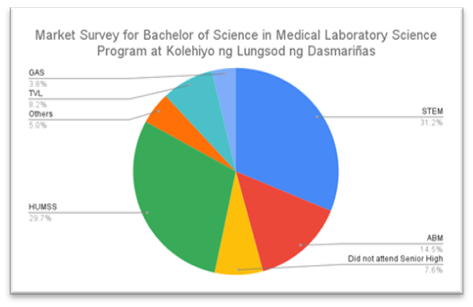
The survey revealed a strong interest in a proposed Bachelor of Science in Medical Laboratory Science program. Out of 317 respondents, 99 (31.2%) were from the STEM strand, indicating the highest level of interest, followed closely by 94 (29.7%) from HUMSS. ABM contributed 46 (14.5%), while 26 (8.2%) were from TVL, 12 (3.8%) from GAS, and 16 (5.0%) were categorized as “Others.” Notably, 24 (7.6%) respondents did not attend senior high school. The data suggest a promising demand for the program within the KLD community.
The survey conducted has indicated substantial interest in a proposed Bachelor of Science in Radiologic Technology program. The survey reached 426 respondents and revealed a strong inclination towards the program. The data shows that the STEM strand comprises the largest portion of potential students, with 166 respondents (39.0%) expressing interest. Following closely, 110 respondents (25.8%) from the HUMSS strand also demonstrated a significant level of interest. The ABM strand accounted for 64 respondents (15.0%), while TVL contributed 34 respondents (8.0%). Notably, 18 respondents (4.2%) indicated they did not attend K-12, and another 18 (4.2%) fell under “Others.” The GAS strand showed 16 respondents (3.8%).
The survey in a Doctor of Medicine program revealed that 38% of respondents were undergraduate students, indicating strong interest among the current student body. Post-graduate students comprised 28%, while bachelor’s degree holders accounted for 25%. The remaining 9% fell into an “others” category. These results suggest a diverse interest in the proposed medical program.